


14. August 2026
EU Sugar market update
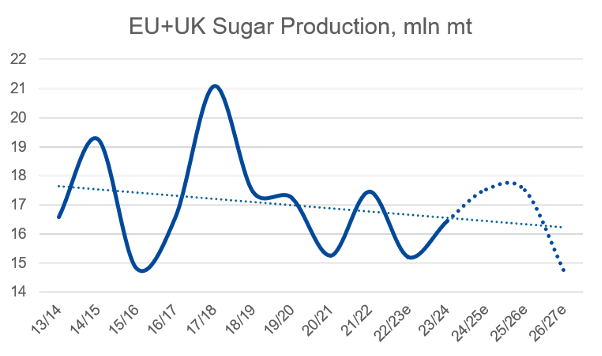
Across Europe, preliminary production figures indicate a total output of around 17.6 million tonnes, broadly in line with the prior year and supported by favorable growing conditions. As a result, after two consecutive strong crops, European sugar stocks have risen to historically high levels of more than three million tonnes, based on preliminary projections for September 2026. Looking ahead, beet acreage has been reduced againthis year and has reached its lowest level since the end of the EU quota regime in 2017/2018. Market consensus currently points to an 8–9 percent reduction of acreage compared with previous year. Nordzucker for example produced approximately 2.8 million tonnes of beet sugar during the 2025/2026 campaign, around 10 percent below the previous year, mainly reflecting strict acreage management. In addition, recent media reports suggest that the number of beet sugar factories in Europe may decline further after the upcoming campaign.
Drought and recurring heat waves are weighing on 2026/2027 sugar yield prospects
The global sugar market has moved away from a clearly bearish surplus environment, with weather-related factors playing an increasingly important role. In Europe, prolonged drought conditions, recurring heat waves and rising disease pressure have affected crop development throughout the summer. The European Commission’s Crop Monitoring Agency (MARS) recently lowered its beet yield forecasts for several countries, including France and Germany, the two largest EU producers. Overall, yields are now expected to be 2.2 percent below last month’s forecast and around 7 percent below last year’s level.
In its latest July outlook, the European Commission therefore expects EU sugar production to decline by 15 percent compared with last year. Based on the updated view, fresh production for 2026/2027 is currently estimated at around 14.9 million tonnes in EU, almost 2.8 million tonnes below the previous year. This would be expected to tighten the EU balance sheet significantly, with ending stocks projected to decline towards twomillion tonnes, import requirements likely to increase and export availability reduced. Overall, this outlook should provide a broadly supportive backdrop for EU sugar prices. At the same time, sugar consumption, including net exports in processed products, is expected to remain broadly stable according to the European Commission.
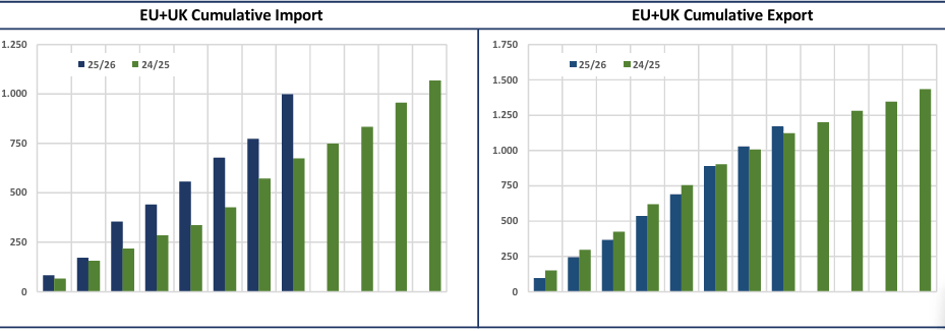
EU imports increased markedly in May. While this was partly driven by front-loaded inward processing reliefflows ahead of the suspension, the main additional volumes came from duty-free preferential cane sugar origins in Southern Africa. Eswatini volumes remained broadly in line with normal trade patterns, while Zimbabwe accounted for the largest share of incremental import growth.
Looking ahead, weather conditions in August will be decisive. Meaningful rainfall and improved growing conditions could help stabilize current production expectations. However, if dryness persists, the market may reassess both European crop prospects and the resulting supply-demand balance. For sugar buyers, this means that procurement strategies should continue to reflect a more balanced risk environment, with close attention to crop progress, import flows, stock developments and price signals across the EU market.